• Payroll Year End 2026
    See our Webinars

KB Category: Sage 50 Accounts

Sage 50 Accounts

Sage 50 Accounts – ‘Your transaction date is set before the current lock date’

Sage 50 Accounts – ‘Your transaction date is set before the current lock date’

When posting a transaction in Sage 50 Accounts, the following message may appear:

‘Your transaction date is set before the current lock date of dd/mm/yyyy.’

This occurs when a lock date has been set on your data and you try to post a transaction dated before the lock date.


Users with access to override a lock date

If you’ve access to override a lock date, you receive the following message:

‘Your transaction date is set before the current lock date of dd/mm/yyyy.
Do you wish to proceed and post to a locked date?
Note – posting with an alternative date may affect your statutory returns.’
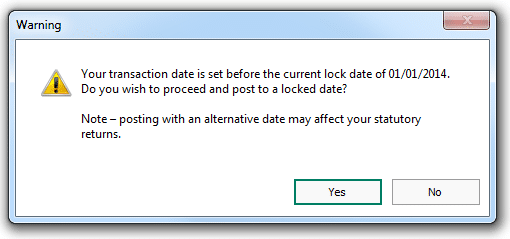
To post into the locked period, click Yes. Alternatively, to return to your transaction to check the date, click No.

Users with no access to override a lock date

If you don’t have access to override the lock date, you receive the following message:

‘Your transaction date is set before the current lock date of dd/mm/yyyy.
If the date is correct please refer to your system administrator or accountant for advice on how to post to a locked date.
Note – posting with an alternative date may affect your statutory returns.’
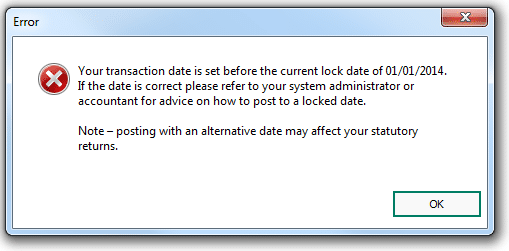
 

The person who logs into Sage 50 Accounts as manager can amend your access rights to allow you to override the lock date. Alternatively, another user who has lock date access can post the transaction for you.

Why don’t transactions appear in the bank reconciliation window

Why don’t transactions appear in the bank reconciliation window

If you can’t find a transaction in the Bank Reconcile screen this can be due to the following reasons:

  • The date of the transaction doesn’t match the reconciliation period.
  • The transaction is entered against the wrong bank account.
  • The transaction is a type that doesn’t appear on a bank.
  • The transaction is grouped with other transactions.
  • The transaction is already reconciled


To identify why a transaction doesn’t appear in the Bank Reconciliation window, locate the transaction in Transactions or Financials , then check

  • Type – ensure it’s a bank transaction. Only bank transactions appear in the Bank Reconciliation window. For example, BR, BP, CR, CP, VR, VP, SR, SP, PP, PR, JC or JD.
  • Account – ensure it’s the correct bank account. The Bank Reconciliation window only displays transactions for the selected bank.
  • Date – the date of the transaction should be on or prior to the reconciliation date.
  • Amount Paid – if the date and reference are the same as other bank transactions, then the transactions may be grouped together in the bank reconciliation window . If the transaction is grouped, only the total value of the grouped transactions appears in the Bank Reconciliation window and this won’t be the same as the Amount Paid column in the transactions or financials window.
  • Bank – check the reconciliation status in the Bank column. This should be N for the transaction to appear in the Bank Reconciliation window. The Bank column may display one of the following:
Bank Column Description
R The transaction has already been reconciled.
N The transaction hasn’t yet been reconciled.
-(Dash) The transaction isn’t applicable for bank reconciliation.


If the transactions still don’t appear after checking the reasons above, you may have corruption in your data. To check:

  • On the menu bar click File then click Maintenance then click Check Data.


How to undo a bank reconciliation

How to undo a bank reconciliation


There may be times where you reconcile one or more bank transactions in error. If this occurs there are two options available to correct this, you can either restore a backup or you can remove the bank reconciliation flag on each transaction.

Restore a backup

If you have a backup that you took before you reconciled, and it’s practical to restore back to that point in time, then this is a quick and simple solution.

Unflag the transactions

If you don’t have a backup, or restoring isn’t practical, you can manually remove the bank reconciliation flag from each individual transaction.

  1. On the navigation bar click Transactions then select the required transaction and click Edit.

Sage Accounts 2014 (v20) and below – On the menu bar click File then click Maintenance. Click Corrections and select the required transactions and click Edit Item.

  1. Clear the Bank rec on check box then click Save then click Yes.

To avoid confusion, we also recommend you remove any .pdf linked to the bank reconciliation you’re undoing. To remove the .pdf, on the navigation bar click Bank accounts then open the required bank account and click Memo. Double-click Statements and right click the statement you want to remove and click Delete.

Bank account appears in red

Bank account appears in red

There are two reasons why your bank account may appear in red:

  • The Balance value is less than the Minimum Limit value.
  • The bank account has not refreshed.This article explains how to check or amend the bank account so it no longer appears in red.

1. Bank > select the relevant bank account > Bank Record.

Sage Accounts 2012 and below – Bank > select the relevant bank account > Record.
2. Check that the Balance value is not less than the Minimum Limit value.

If required, increase the value in the Minimum Limit box.
3. Save.

Tip: When you click Save, even if no changes have been made this refreshes the bank account.

‘Processing, Please Wait’ – Window coming up when you are NOT using Sage Drive

‘Processing, Please Wait’ – Window coming up when you are NOT using Sage Drive


Uploading data window scrolling in continuous loop with message, “Processing, please wait…”

This can happen whether you have Sage Drive set up or not.

Solution


Delete the Sage Drive files – if NOT using Sage Drive  – Only follow these steps if they are NOT using Sage Drive


You must follow the steps below on the computer where your data is held. If you’re using a networked version of Sage Accounts, all other users must log out of the data.

1>Press the Windows Key + R on your keyboard > enter Services.msc > OK. OR through Control panel> Administrative Tools>services

2> Scroll down find and stop the following services: Right-click the required service > Stop.

  • Sage 50 Accounts Control v23
  • Sage 50 Accounts Service v23


3> Press the Windows Key + R > browse to:

  • 32 bit operating system: C:\Program Files\Sage\AccountsServiceV23
  • 64 bit operating system: C:\Program Files (x86)\Sage\AccountsServiceV23

4> For each of the following files, right-click the file > Delete > Yes.

  • Sg50Svc_v23.sqlite3
  • Sg50Svc_v23.sqlite3-Shm
  • Sg50Svc_v23.sqlite3-wal

5> Close the browser window and start the following services:

To start a service press the Windows Key + R on your keyboard > enter Services.msc > OK > right-click the required service > Start.

  • Sage 50 Accounts Control v23
  • Sage 50 Accounts Service v23

Slow running Bank Rec Report

Running the bank rec report was taking some time to run and the same amount of time to export to excel.

Report Running Slow

Report from the bank rec screen taking a very long time to come up


Solution

Untick the box(Group items in Bank Rec) try report again it should instant or a lot quicker


Please Note: To group bank payments and bank receipts, which have the same reference and date in the bank activity, select this check box.

Note: This doesn’t work retrospectively. If you change this check box, it only affects transactions that you post after you change the setting.


Fixing bucket corruption

Fixing bucket corruption

Within each nominal, customer and supplier record, the monthly values in the Actuals column are called buckets. Bucket corruption occurs when one or more of these bucket values disagree with the total on the record activity for the same period.

A common symptom of nominal bucket corruption is if the debit and credit totals on the trial balance report don’t match.


Fixing bucket corruption

Did you find this video helpful?

To fix bucket corruption

Note: Before you follow these steps, in Help > About you must check when the clear audit trail was last ran. If you’ve cleared the audit trail using a date within the current financial year, the monthly buckets prior to the clear audit trail date will be incorrect after recalculating. In this scenario, print any required reports before you recalculate.

Sage 50 Accounts 2012 (v18) and above

  1. File > Maintenance > Yes to close any open windows.
  2. Check Data > Recovery Tools > follow the prompts to take a backup of your data > OK.
  3. Recalculate Period Values > OK > Close > Close.


Sage 50 Accounts 2011 (v17)

  1. Take a backup of the data.
  2. File > Maintenance > Recalculate.


Note: Revaluation transactions may be added to the bucket values on rebuild.

Possible causes and best practice

Bucket corruption may be caused by issues including crashes and power failures. There are also some specific causes that you should be aware of:

  • Crashing out of the Year End process – The Year End process may take some time to run, during which the Task Manager may show ‘Not Responding’. You should not crash out of the year end routine.
  • 3rd party data import – Data imported from third party software may cause bucket corruption. You should check your bucket values are correct after such imports.
  • Nominal codes missing from the chart of accounts – Before running the Year End routine it is important to check the chart of accounts to ensure no codes are missing

Aged Creditors does not reconcile to Creditors Control

Aged Creditors does not reconcile to Creditors Control

It’s good practice to reconcile the balance on your Aged Creditors nominal code with an aged creditors report. There may be occasions where the figures do not balance and there are a number of reasons why this may happen. This article is designed to help you to quickly locate and resolve any discrepancies in the figures.

For help with reconciling your aged debtors balance, please refer to article 14319

Go through the detailed steps in order, from Step 1 to 7 to find out why your creditors not balancing:


  1. Ensure that you run the correct aged creditors report with the correct criteria
  2. Ensure that you run the correct trial balance report with the correct criteria
  3. Check for journals posted to the Creditors Control Account nominal code
  4. Download and run the Aged Reconciliation reports
  5. Run Check Data to check for errors or a warning relating to the purchase aged balance
  6. Check for bucket corruption
  7. Check for currency corruption


Pimbrook Software
Privacy Overview

This website uses cookies so that we can provide you with the best user experience possible. Cookie information is stored in your browser and performs functions such as recognising you when you return to our website and helping our team to understand which sections of the website you find most interesting and useful.